


Embroidery converses across centuries
Su stitching techniques give needlework remarkable dimensionality, creating dialogue with multiple generations, Wang Qian reports.










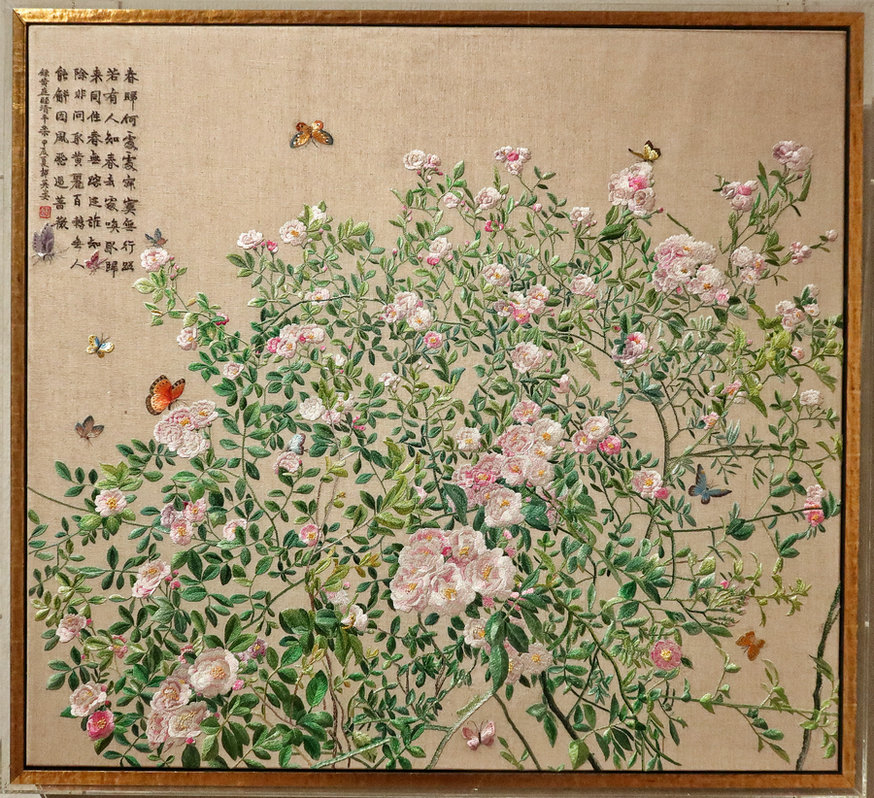
Born in Zhenhu in the west of Suzhou's new district, known as the cradle of Su embroidery, Zou began learning the technique at the age of 6 beside her mother's embroidery frame. Dating back more than 3,000 years, the craft originated in the Three Kingdoms Period (220-280), and double-sided embroidery is one of its excellent examples.
"I learned the language of the needle before I fully learned my own," she says. That foundational fluency allowed her to become an innovator. Her patented didi stitch, or drop-by-drop stitch, uses points mere fractions of a millimeter apart to create a surface that seems to breathe.
"It gives embroidery a sense of respiration, a matte elegance," she says.
Her pioneering work has drawn the attention of scholars. "In my opinion, Zou is one of the most genuinely creative representatives of Su embroidery today," says Shang Gang, a retired professor from Tsinghua University's Academy of Arts and Design. "She has transformed needlework from a craft into a true art form that expresses ideas, giving flat embroidery a remarkable, living dimensionality."