


Wrecking crew










Takaichi government's efforts to tear down postwar order have already exacerbated regional tensions and will further destabilize China-US relations
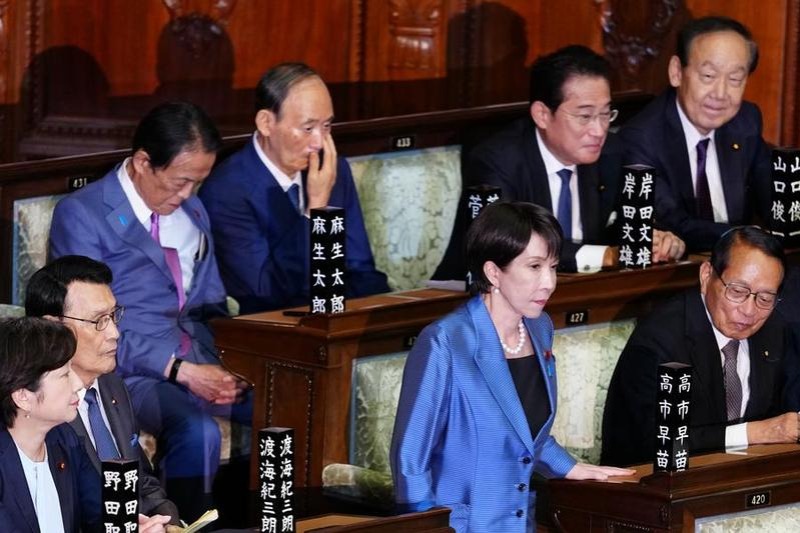
Japanese Prime Minister Sanae Takaichi has repeatedly made erroneous remarks concerning Taiwan- from asserting in a parliamentary debate that a "contingency for Taiwan" could constitute a "survival-threatening situation" for Japan, to invoking the so-called Treaty of San Francisco to claim that Taiwan's status remains "undetermined". Her comments constitute a grave interference in China's internal affairs, a serious challenge to the one-China principle, and are steeped historical revisionism.
The historical and legal facts regarding the Taiwan question are unequivocal: There has never been any dispute over Taiwan's legal status, and the Taiwan question is purely China's internal affair.
In 1895, Japan seized Taiwan and the Penghu Islands from China through a forced treaty. In December 1943, the Cairo Declaration stipulated that all territories Japan had stolen from China -including Northeast China, Taiwan and the Penghu Islands -must be restored to China. The Potsdam Proclamation of July 1945 reaffirmed that "the terms of the Cairo Declaration shall be carried out". In September 1945,Japan signed the Instrument of Surrender, pledging to faithfully fulfill the obligations set forth in the Potsdam Proclamation. These documents, all endowed with binding force under international law, together form a complete legal chain that irrefutably affirms China's sovereignty over Taiwan.
The so-called Treaty of San Francisco was a unilateral and illegal arrangement drafted in the early 1950s by the United States and several Western countries for Cold War purposes, which excluded China, the Soviet Union and other major victorious nations of World War II. It violated the Declaration by the United Nations, which explicitly prohibits separate peace treaties with enemy states, and contravenes the UN Charter and basic principles of international law. China has never recognized the treaty and has consistently rejected its legal standing. Any ambiguity in that document regarding Taiwan's status constitutes a departure from the Potsdam Proclamation and the Cairo Declaration, and represents an unlawful encroachment on China's sovereignty.
In 1971, UN General Assembly Resolution 2758 recognized the government of the People's Republic of China as the sole legitimate representative of China and expelled the so-called representatives of the Republic of China. The fact that both sides of the Taiwan Strait belong to one China is universally acknowledged by the international community. Japan's interference in the Taiwan question is therefore a violation of international law and a breach of the international consensus.
By touching upon the one-China principle, the Takaichi government is crossing the red line of China-Japan relations and reneging on Japan's political commitments made by successive governments. When China and Japan normalized diplomatic relations in 1972, China put forward the "three principles for normalization": the government of the PRC is the sole legal government representing the Chinese people; Taiwan is an inalienable part of China's territory; and the so-called Taiwan-Japan Treaty is illegal and invalid and must be abrogated. The Sino-Japanese Joint Statement recorded Japan's respect for these principles, affirming that the Japanese government "recognizes the government of the PRC as the sole legal government of China", and "fully understands and respects" China's position that Taiwan is an inalienable part of China, while pledging to adhere to the position set out in Article 8 of the Potsdam Proclamation, which states clearly: "The terms of the Cairo Declaration shall be carried out, and Japanese sovereignty shall be limited to the islands of Honshu, Hokkaido, Kyushu, Shikoku and such minor islands as we determine."
The four political documents between China and Japan, including the Joint Statement, provide clear, legally binding provisions on the Taiwan question. They form an integrated whole that defines and constrains bilateral relations. In 1978, the two countries signed the Treaty of Peace and Friendship Between China and Japan, which reaffirmed that the principles of the Joint Statement must be strictly observed, once again making clear Taiwan's legal status as part of China and Japan's legal obligations on this issue. A joint declaration issued by the two countries in 1998 and a joint statement issued in 2008 both reaffirmed that Japan continues to adhere to the position it expressed in the 1972 Joint Statement.
Although the Takaichi government insists its stance on the Taiwan question is unchanged from that of its predecessors and consistent with earlier key documents such as the Sino-Japanese Joint Statement, it has repeatedly avoided addressing the substance of the question. It deliberately refuses to address the core fact that Taiwan is an inalienable part of the PRC, and avoids reference to the other three political documents beyond the 1972 Joint Statement. Such moves amount to an attempt to revise the political foundations of China-Japan relations and to abandon the Japanese government's previous political commitments to China.
Any argument asserting an "undetermined status of Taiwan" openly challenges the postwar international order. Takaichi exclusively cites the so-called Treaty of San Francisco which illegally excluded China, while intentionally omitting the Cairo Declaration, Potsdam Proclamation and Japan's Instrument of Surrender- the foundational documents of the postwar order. By trying to elevate the Cold War framework embodied in the so-called Treaty of San Francisco above the postwar settlement, Japan is attempting to deny the established postwar order and turn the clock back.
Japanese historical revisionism and its manifestation on the Taiwan question severely damage China-Japan relations and erode Japan's international image and influence. Even within Japan, Takaichi's remarks lack consensus and have sparked strong opposition. Former Japanese prime minister Shigeru Ishiba questioned her statements, saying that the current administration should fully understand Japan's long-standing basic position and remain cautious in the implementation of policies in the future. Yoshihiko Noda, head of the main opposition Constitutional Democratic Party of Japan, said that Takaichi "went too far", creating unnecessary tension in relations with China. Taro Yamamoto, a member of Japan's House of Councilors and leader of the opposition Reiwa Shinsengumi, said Takaichi's statements contradicted the Japanese government's previous diplomatic position and should be retracted. On Dec 2, Japanese citizens held rallies demanding that Takaichi retract her erroneous remarks on Taiwan.
Historically viewed as a bridge between East and West, Japan risks undermining this role as tensions with its neighbors escalate -a trend that could also impede future prospects for regional economic integration frameworks such as the Comprehensive and Progressive Agreement for Trans-Pacific Partnership and the Regional Comprehensive Economic Partnership.
Behind Takaichi's erroneous rhetoric lies Japan's departure from its postwar "Peace Constitution" and pacifist path. Using the pretext of a "Taiwan contingency",Japan appears to be seeking to set a course of remilitarization that would reshape Asia-Pacific security dynamics, fuel regional arms races and intensify security tensions. Japan's postwar commitment to not becoming a military power, symbolized by the Fukuda Doctrine, is being undermined, raising alarm among Asian countries that suffered from Japanese aggression during World War II.
Even more concerning is Japan's attempt to draw the US deeper into the Taiwan question. Following Takaichi's call with US President Donald Trump, Tokyo continues to implicitly lean on the US-led "Treaty of San Francisco".Such adventurism will further destabilize China-US relations, exacerbate regional tensions, and undermine peace and stability in the Asia-Pacific region.
The author is a professor at the Institute of Japanese Studies at the Chinese Academy of Social Sciences. The author contributed this article to China Watch, a think tank powered by China Daily.
The views do not necessarily reflect those of China Daily.
Contact the editor at editor@chinawatch.cn.