


Postgrad exam trend points to thoughtful approach









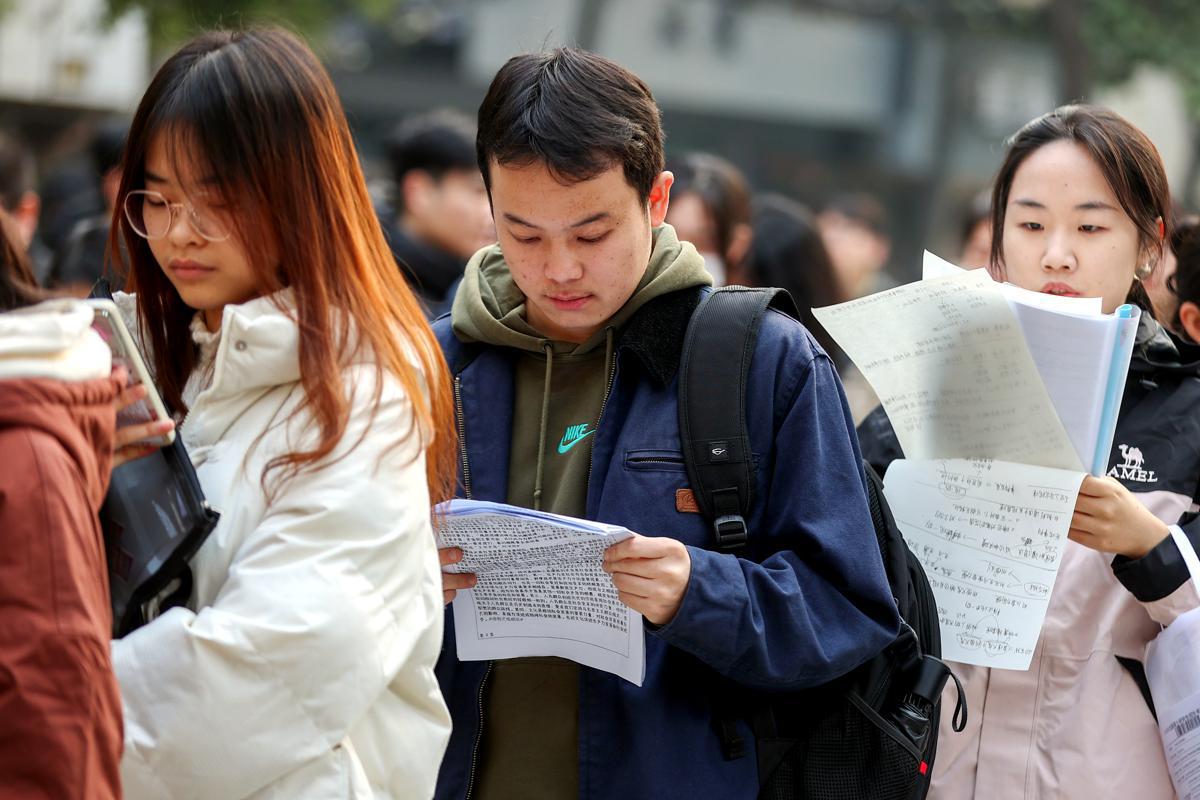
Millions appeared for this year's national postgraduate entrance examination over the weekend, but the number of candidates taking the test has been declining over the past three years, a trend that experts said reflects a more rational and deliberate approach among students toward further education.
The message is clear, the expert said. Today's students are thinking twice before committing to further studies, instead making choices that are more calculated, calm and self-aware than before.
According to the Ministry of Education, 3.43 million candidates appeared for the examination this year, down from 3.88 million last year and continuing a downward trend since the 2023 peak of 4.74 million.
Experts said the sustained decrease reflects a cooling of what was once a "postgraduate exam fever", with students becoming more rational and less inclined to follow the crowd.
Wang Shutao, a professor at Xiamen University's Institute of Education, told China Youth Daily that in the past, students were either swept along by the crowd or sought a master's degree as a default option. "Now, students are weighing postgraduate studies against other career paths with clearer personal and professional goals in mind."
Chen Zhiwen, editor-in-chief of education website EOL, noted that this is the first significant three-year decline since the start of the century. "Some of the impulsive applicants have stepped back," he said, attributing the drop partly to students refraining from blindly following the herd.
Experts said the sustained decrease in the number of examinees is not merely a quantitative change but also an opportunity for structural optimization and quality enhancement in postgraduate education.
Hu Xiangdong, a professor at Central China Normal University's measurement and evaluation research center, said: "The adjustment over the past three years is not just a fluctuation in numbers. It represents a critical turning point for postgraduate education, transitioning from scale expansion to structural refinement and quality improvement."
He added that this shift presents an opportunity to better align talent cultivation with societal needs, enhance the value of a postgraduate degree, and strengthen the employability of graduates.
Wang Chuanyi, deputy director of Tsinghua University's Research Institute for Graduate Education Strategy, said universities are implementing stricter quality control in postgraduate training, with rigorous entry and graduation standards becoming the norm. This has led to some students with weaker academic foundations reconsidering their options, he told China Education Daily.
Positive significance
In this context, Wang Shutao from Xiamen University said that he believes the decline in the number of candidates carries positive significance for those still intent on pursuing higher studies. "When taking the exam is no longer a choice driven by herd mentality, but a decision based on genuine academic interest and career planning, postgraduate education can better cultivate talent with both broad knowledge and professional depth," he said.
This trend also sends a positive signal for postgraduate education in China, which is transitioning from expanding enrollment numbers to optimizing structure and enhancing quality, he added.
Parallel to the decline in application numbers has been a shift in candidates' motivations. According to a survey conducted in late October by the measurement and evaluation research center of Central China Normal University, the primary reason cited by students for pursuing postgraduate studies is increasingly shifting from "obtaining a higher degree" to "enhancing career development prospects".
The survey questionnaire, which allowed multiple choices, found that while 55.87 percent of undergraduates surveyed still consider postgraduate study the main option after graduation, a significant proportion — 51.4 percent — are leaning toward direct employment, with others considering civil service exams (23.24 percent) or studying abroad (6.7 percent).
Such diversified planning indicates that most students are keeping their options open rather than rigidly committing to a single path. Hu from Central China Normal University said it reflected a more prudent evaluation of the returns of postgraduate education.
The cooling interest in postgraduate studies also coincides with gradual changes in the labor market's evaluation criteria.
Survey data from the center indicated that while about 20 percent of employers still regarded a master's degree as a significant advantage, a majority — 70.83 percent — believed its relative edge in actual recruitment has diminished.
"This suggests that in a considerable number of recruitment scenarios, a higher degree is no longer the decisive factor it once was," Hu said.
Wang from Xiamen University said that although academic credentials remain a useful screening tool in an information-asymmetric job market, competencies such as innovative thinking, adaptability and complex problem-solving are gaining prominence as new benchmarks for talent.
zoushuo@chinadaily.com.cn






- Vice-chairman of CPPCC Jiangxi Provincial Committee placed under investigation
- Five trapped in flooding accident at Heilongjiang coal mine
- Long March 5 rocket deploys tech demo satellite into space
- China launches communication technology test satellite
- Spokesperson warns against aggression toward mainland fisherman
- Lhasa wetland reserve recognized as world's highest altitude wetland