
Many white collar workers in Guangzhou got off on the wrong foot Monday morning, as taxi drivers decided to "take the day off" or "have tea", according to Nanfang Daily.
Taxis were few and far between at the bus and train stations.
Accustomed to waiting no more than 10 minutes for a cab, passengers found themselves queuing up for half an hour or more.
I had flown into Guangzhou that evening. Fortunately, I did not have to take a cab, but the news was still disconcerting.
In the past month, taxi drivers have gone on strike in many Chinese cities, including Chongqing, Sanya in Hainan province, and Zhouzhi county in Shaanxi province.
Although the strikes have caused a lot of inconvenience, the public is generally sympathetic.
Most passengers have heard drivers complain about how difficult their job has become. Over the past 20 years, driving a taxi has changed from a coveted and highly profitable profession to a competitive, ill-paid rat race.
As a Beijinger, I started riding taxis in the late 1980s. At that time, most taxi drivers were proud of their jobs. They worked for a few State-owned taxi companies and underwent six months to a year of training before they got behind the wheel.
Most of their passengers were foreigners and they were well paid, often in foreign exchange certificates (FEC). Also known as "funny money", FECs were worth much more on the black market than their face value.
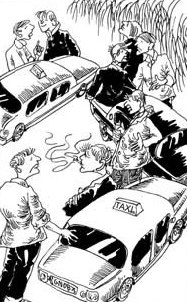
In those days, ordinary Chinese only hailed a cab in an emergency. It was all but impossible to find a taxi on the street; you had to phone the company or go to a fancy hotel.
A friend who drove a cab told me that he and his colleagues made a few thousand yuan a month, compared to the few hundred I made.
Today, people in other professions have seen their incomes increase ten-fold; many now drive their own cars. Meanwhile, taxi drivers work longer hours and earn less money as more and more cabs, legal and illegal, compete for fares.
But it is not just competition that plagues taxi drivers. Most of them depend for their livelihood on companies that take the lion's share of their fares in return for ill-defined services.
Over the past 30 years, tens of millions of people in China have gone into business for themselves. Very few taxi drivers are self-employed, however; almost all are dependent on taxi companies for their licenses.
In many cases, these companies enjoy a virtual monopoly, and they are invariably supported by local governments. The companies take between 50 to 70 percent of the drivers' income, and often fail to provide basic services.
I once heard a woman driver say she wasn't sure her basic health care was covered or her social security paid.
The newest drivers are at the bottom of the heap. Many do not know what their rights are, even though they pay a small fortune for their licenses.
Now that drivers have started to protest, some local governments have come up with measures to address their grievances.
Until there is a comprehensive effort to rein in the taxi companies, however, expect to find more drivers "having tea".
E-mail: lixing@chinadaily.com.cn
(China Daily 12/04/2008 page8)