


Horsemen safeguard remote borders
Officers' patrols, rescue efforts a lifeline for those struck by torrid winter conditions in northern Xinjiang









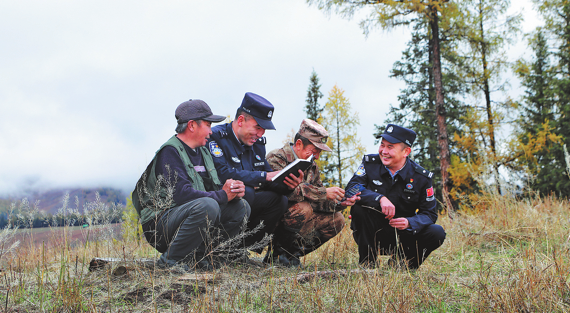
At the very edge of China, in the country's rugged and spectacularly beautiful northwest, the local police watch over the borders of Kazakhstan to the west, Russia to the north and Mongolia to the east.
This breathtaking area, Burqin county in the Xinjiang Uygur autonomous region, while stunning to the eye with its vast dense forests, spellbinding lakes and towering mountains, can be deadly when winter sets in starting from October and continuing for half the year.
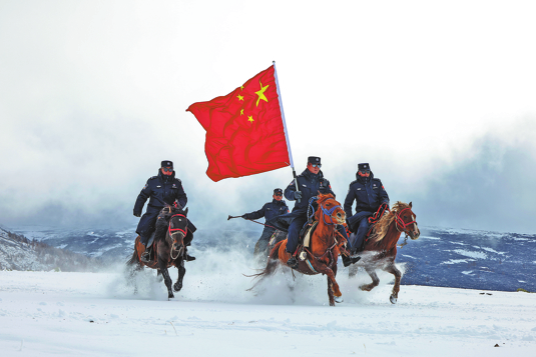
"When the snow buries the roads, our horses become lifelines. How else can we respond to emergencies?" said Zhu Peicai, head of the Border Police Station in the Kanas Scenic Area in Altay prefecture, which administers Burqin.
Each October, winter begins to lay its siege on the snowcapped peaks of the Altay Mountains. Despite its beauty, this pristine white world hides peril at every turn — treacherous terrain, hidden crevasses beneath the snow, and the ever-looming threat of avalanches.
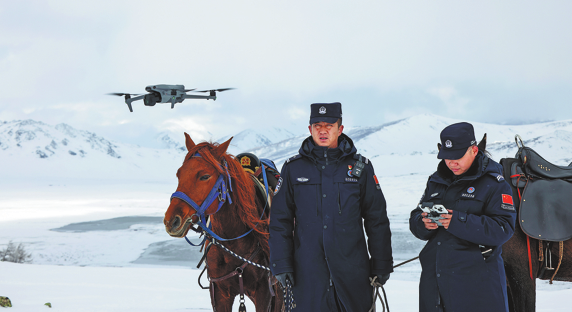
In a land where temperatures plummet to — 30 C and below, and snowdrifts reach three meters deep, their most reliable tool isn't a high-tech vehicle but a humble horse. "Riding a horse is as essential for us as driving a police car," said Zhu, his voice weathered by 15 years of shouting over howling winds.
At 1,324 meters above sea level, the police station oversees 817.63 square kilometers of rugged terrain. It also watches over a 77.165-km border, with the unique geography demanding constant vigilance. The station's 24 officers and seven auxiliary officers — with an average age of just 29 — serve a diverse community of 1,037 residents from six ethnic groups, 80 percent of whom are Mongolian.
Founded in 1964, this young yet seasoned team has turned adversity into routine. Their days often begin with vehicle patrols and end on horseback once the snow becomes impassable.
As the first snowflakes fall on Kanas, and the region settles into a half-year winter slumber, some braver tourists are drawn to the area's otherworldly beauty.
"Unscrupulous and unlicensed tour guides often lead groups into unopened areas without proper preparation," Zhu said. "When blizzards hit or ice forms, these visitors become trapped with no way to call for help."
In October alone, the station rescued over 140 lost or stranded tourists, a testament to the risks lurking beneath Kanas' scenic surface.
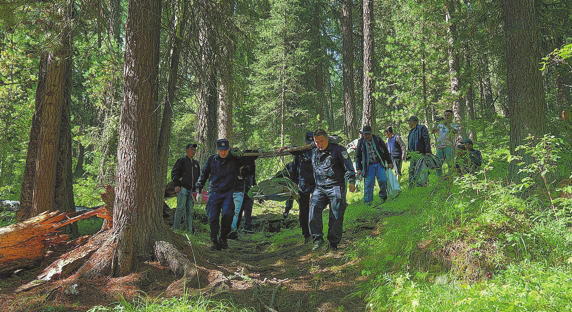
On Oct 1, heavy snow trapped 110 tourists in the Black Lake area, which is about 15 km from the station between the Kanas and Hemu scenic areas. The spot attracts hikers and adventurers with its inky waters and remote location. The unopened region is home to wolves and bears, and lacks a phone signal.
Police vehicles were unable to reach the stranded tourists, so the officers made their way on horseback. After more than 30 hours, all of the tourists were brought back safely.
Zhu said two policemen at the station had their buttocks chafed so raw from the long hours of jolting on horseback that they had to sleep on their stomachs for several days.
As winter tightens its grip on Kanas, the officers need to patrol the area on horseback two to three times per week, traversing 15 km to Black Lake and beyond. They check for illegal hunting, stranded travelers and signs of border activity, their binoculars scanning the horizon for any sign of trouble.
"Once the snow falls and freezes, the trail often becomes a death trap," said officer Wang Yicheng. "Without a telephone signal, anyone stranded faces hypothermia within hours. We check for fresh footprints — hikers, herders, livestock — every patrol, and persuade anyone we find to turn back. Their safety is our top priority."
For these officers, danger isn't just a possibility, it's a regular companion. Wang still shudders recalling the avalanche that struck in January last year — a once-in-a-decade disaster that tested the team's courage to its limits.
"A wall of snow as tall as a house crashed down just 1.5 meters behind me. That was the closest I've ever been to death," he said, his voice steady but his eyes reflecting the trauma.
The avalanche buried 200 meters of road, snapping steel cables along the roadside and trapping hundreds of vehicles with over 1,000 tourists. Kanas village, cut off from electricity and communication, became an isolated island.
Before setting off to carry out his duty, Wang left his ID card and emergency contact information with scenic area staff. "If I didn't come back, they could notify my family," he said. He then joined the rescue effort.
For five days, the team survived on naan bread and snow melt water, their shoes soaked through, as they organized volunteer police to evacuate the stranded. Each carried a satellite navigation tracker, a lifeline in case a second avalanche buried them. When he finally returned home after the last tourist was safely transferred, he didn't tell his family about the ordeal — he still hasn't. "I didn't want them to worry," he said.
The physical toll of these missions is tangible. Wang Jia, the station's political commissar, described his border patrol experience of riding for 12 hours straight over 70-degree slopes, where the trail narrows to just 40 centimeters — barely enough for a horse to pass.
"On one uphill stretch, my horse got tired and slipped backward, and I fell off the horse," he said. "For a moment, I thought it was over. All I could think about was my wife and kids. Luckily, I grabbed the reins just in time, and it saved my life."
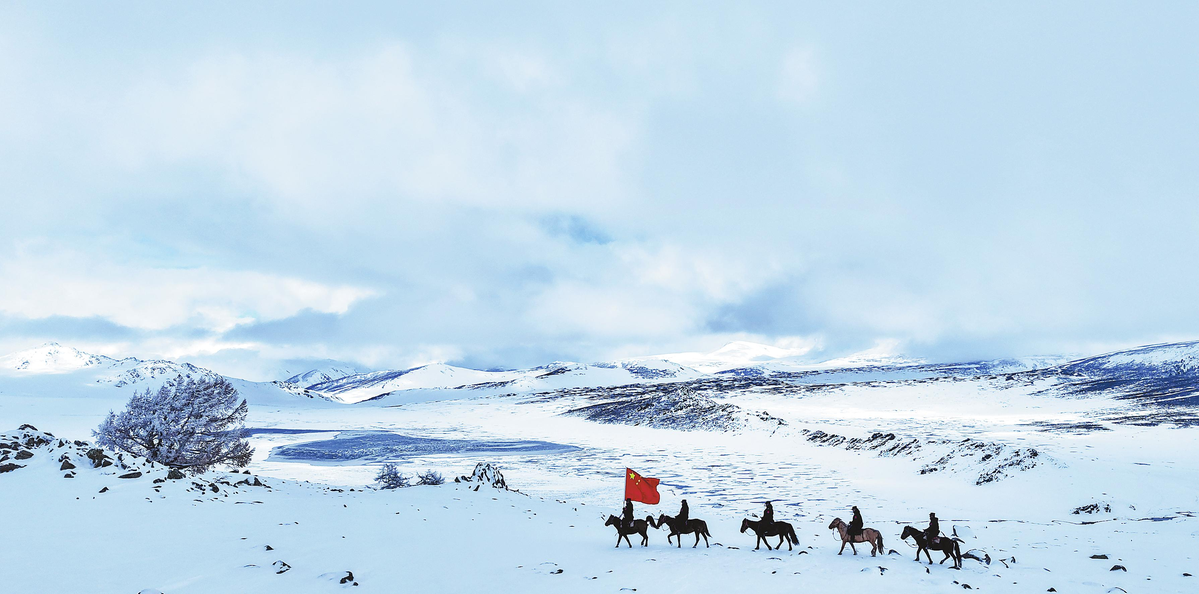
Such rides leave even the strongest officers sore and bruised, but the reward of planting the national flag at the China-Russia No 4 Border Marker makes it all worthwhile. "Standing there, seeing the flag flutter against the snow, every ache is worth it," Wang Jia said.
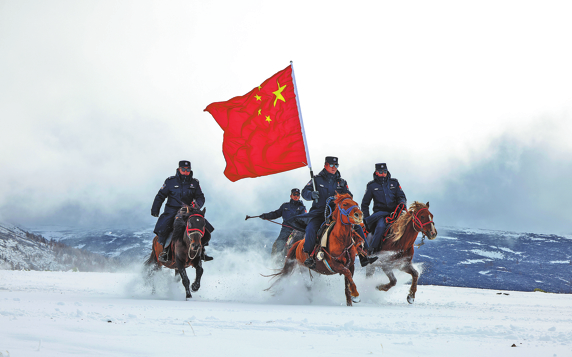
This type of border patrol is carried out twice a year, each time lasting more than five days. Most of the border is located in the alpine region, requiring the police to travel back and forth over a distance of more than 100 km. Along the way, the police traverse forests, swamps, glaciers and even deserts.
"No people, no footprints and the border line that is intact — this is the significance of our presence there," said officer Liu Ailong.
Beyond border patrols, the officers also serve as the backbone of the local community's grassroots governance. "We're not just police — we're neighbors," Liu said. "Every day, we check in with shop owners about fire safety, help herders with paperwork and answer tourists' questions. Small things make a big difference in keeping the peace."
A simple wooden mediation table outside the police station has become a hub for resolving disputes.
When a guesthouse owner and a construction company clashed over payment last year, officer Wang Yicheng brought them together, mediating a solution that satisfied both sides.
"We need to provide villagers with a place to reason things out and seek justice. Clarifying issues openly at the table will reduce everyone's confusion and conflicts," Wang Yicheng said.
By talking through issues calmly with reason and empathy, most problems can be solved through mediation, eliminating the possibility of escalation, he added.
As of October, the station had handled over 900 rescue calls for the year, saving more than 300 tourists and herders and recovering over 4 million yuan ($566,444) in economic losses. Their dispute mediation rate stands at 100 percent, a testament to their commitment to "resolving conflicts locally, ensuring safety and never failing to serve".
These achievements have earned them numerous accolades, including three collective third-class merits and the title of Advanced Collective of National Public Security Organs from the Ministry of Public Security.
For Zhu, the station chief, who has dedicated half his life to this land, the work is more than a job — it's a calling.
"We come from all over China, far from our families," he said. "But here, we're a family. We share the hardships and the triumphs, all for the sake of protecting this beautiful place and the people who live and visit here."