



China plans to play a bigger role in Antarctic governance
Draft law intends to contribute to country's wisdom and solutions









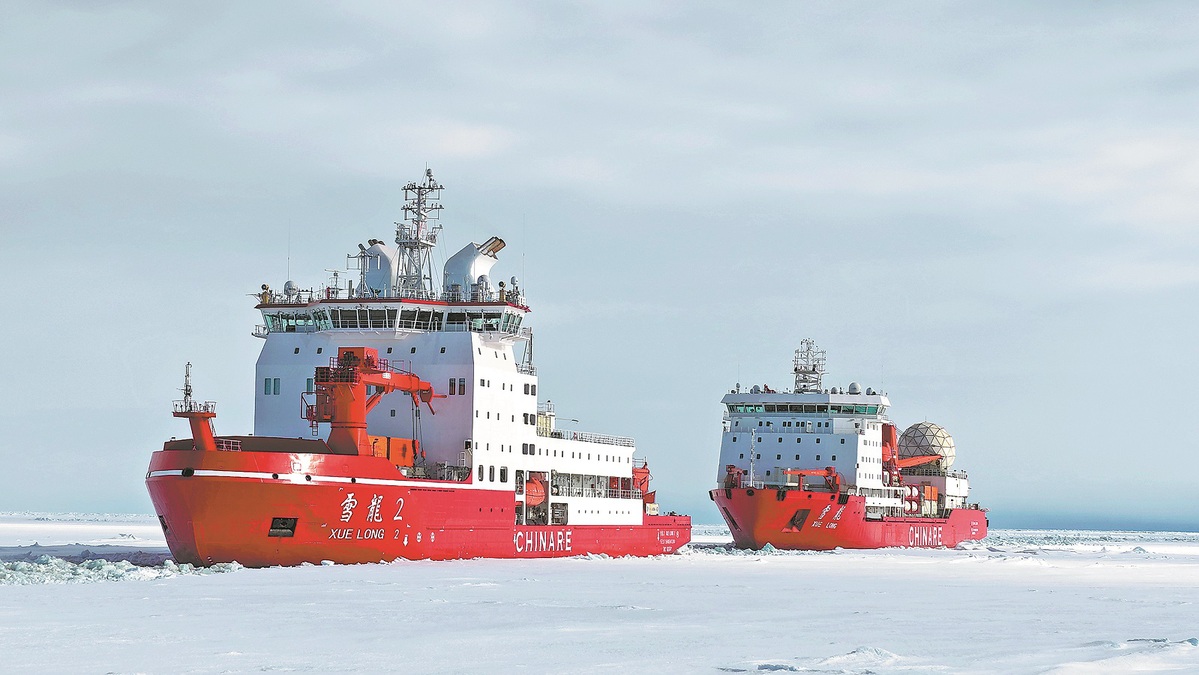
Chinese lawmakers are reviewing a draft law governing activities and environmental protection in Antarctica as the country steps up efforts to strengthen its polar capacity and participate more deeply in global governance of the continent.
The draft, consisting of seven chapters and 57 articles, was submitted on Monday to an ongoing session of the Standing Committee of the National People's Congress, China's top legislature, for a first reading.
"Antarctica remains the only continent without a clearly defined sovereign claim and is mainly governed through international mechanisms such as the Antarctic Treaty Consultative Meeting," Lu Xinshe, head of the NPC Environmental Protection and Resources Conservation Committee, told lawmakers while explaining the draft.
Lu said international governance of Antarctica largely depends on each country's capabilities in conducting Antarctic activities and its influence in shaping international legal frameworks and behavioral norms. He noted that most of the 29 consultative parties to the Antarctic Treaty have enacted national legislation specifically addressing Antarctic affairs.
The draft law, he said, will help present China's concepts and institutional framework for participating in Antarctic governance to the international community, clarify its policy positions, and contribute what he described as Chinese wisdom and solutions to managing international affairs in the Antarctic region.
Tan Xianchun, a researcher at the Institutes of Science and Development of the Chinese Academy of Sciences, said China has become increasingly active in shaping the Antarctic governance framework and agenda as its comprehensive national strength and scientific capabilities have grown.
After more than four decades of Antarctic scientific research, China has established a research station network covering all five major regions of the continent, Tan said, marking its transition from a participant in polar exploration to a major polar power. She cited China's proposal for green exploration at the 40th Antarctic Treaty Consultative Meeting in 2017 as an example of the country acting as a responsible major nation.
"The draft marks a new phase in China's polar endeavor, shifting from capacity building to rule shaping," Tan said. She added that the proposed law integrates principles that include peaceful use, environmental protection, resource conservation, scientific and technological support, and international cooperation into a practical and accountable legal system, with mechanisms covering preapproval, supervision and post-incident accountability.
Taking into account international treaty obligations and the practical needs of managing China's Antarctic activities, the draft sets out rules for expeditions, fisheries, tourism and shipping. It applies to Chinese citizens conducting Antarctic activities, as well as to foreign individuals who organize Antarctic activities within China's jurisdiction or depart from China for Antarctic expeditions.
The draft stipulates that, except for scientific research or other peaceful purposes, military-related activities in Antarctica are prohibited. It also bans activities related to mineral resources, except for scientific research.
The proposed law encourages Antarctic endeavors, promotes green and low-carbon activities, and supports basic research and technological innovation.
Ma Jun, founding director of the Beijing-based Institute of Public and Environmental Affairs, said the draft also addresses regulation of Antarctic tourism, an emerging issue in Antarctic governance.
"Antarctica has an extremely fragile ecosystem, with limited capacity for recovery and resistance to invasive species," Ma said. "With the surge in tourist numbers, risks such as the introduction of alien species, habitat damage, oil spills, and garbage and plastic pollution could exceed the continent's environmental carrying capacity, leading to irreversible consequences."
The draft sets out overarching requirements for environmental protection, establishes an environmental impact assessment system, regulates emergency environmental responses, and specifies detailed measures for protecting flora and fauna, managing waste, preventing marine pollution, and preserving historical sites.
"Through national legislation that ensures coordinated oversight and management of Antarctic activities, the draft demonstrates China's commitment to the peaceful use of the continent and underscores its role as a responsible major power," Ma said.




- China plans to play a bigger role in Antarctic governance
- Striking the right note to advance climate change action
- Shanxi ends province-wide blanket fireworks ban
- Audit: China fixes bulk of fiscal problems tied to 2024 budget
- China reports major gains in circular economy
- Chinese lawmakers review draft revision to banking supervision and regulation law