


Tea sector blends commerce with cross-Strait exchanges
Fujian plans to capitalize on strengths of both sides to push deeper integration









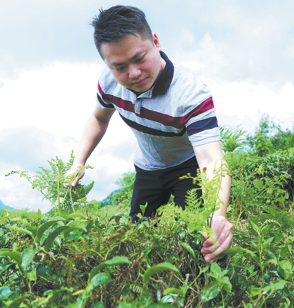
Nestled in the misty mountains of Fujian province, an eco-friendly tea garden run by Taiwan farmer Peng An-yuan showcases a rare coexistence of tea plants and wild grasses, creating a natural sanctuary for beneficial insects.
Peng's family introduced Oriental Beauty, a prized oolong variety from their hometown of Hsinchu, Taiwan, to Datian county in Sanming. The mountainous area shares similar climate and ecological conditions, making it suitable for the tea's cultivation.
The tea's distinctive character lies in a production process whereby, as growers say, "bugs do half the work". Small green leafhoppers bite the tea leaves, triggering a natural reaction that infuses the tea with a sought-after fruity and honey-like aroma. The leaves develop dark purple and brown tones covered with fine white hairs.
"The tea jassids feeding on the leaves are essential, but we never know when or how they will bite -it's unpredictable, and that's what makes this tea so precious," said Peng, the inheritor of Taiwan's Oriental Beauty tea making tradition on the Chinese mainland.
He said the wild grasses surrounding the tea plants act like a "five-star hotel" for the leafhoppers, underscoring the importance of a healthy local ecosystem to the garden's success and long-term investment.
Sanming, with a forest coverage of 78 percent, is often dubbed China's "Green City" for its abundant natural resources. In November 2022, the city received approval from the central government to build the mainland's first cross-Strait rural integrated development pilot zone.
As Datian county expands its tea industry, Peng has helped facilitate exchanges between Taiwan tea experts and mainland producers, significantly boosting output. The county now produces 4,300 metric tons of Oriental Beauty tea annually, accounting for 70 percent of the mainland's total output. The tea is exported to Europe and Southeast Asia.
In November, the Fujian Provincial Administration for Market Management released a cross-Strait Oriental Beauty tea processing technical regulation. The standards were jointly drafted by tea associations and universities from both the mainland and Taiwan to promote deeper integration of the industry across the Strait.
"Rural integration requires cross-Strait cooperation, and Taiwan people need their mainland counterparts in a different environment," Peng said. He has fully integrated into the local community, working long term with a mainland partner, marrying a local woman and welcoming their firstborn last year.
Driven by supportive policies, Sanming has seen a growing number of similar cases blending Taiwan expertise with local resources. Over the past three years, the city has approved 106 new Taiwan-invested enterprises with a total investment of 801 million yuan ($114 million) and established 12 bases for Fujian-Taiwan agricultural integration.
In Jianning county, Taiwan entrepreneur Lin Hsiu-ying operates an oil tea camellia cooperative that applies Taiwan techniques to boost production. The project has increased the income of 112 local households by an average of over 4,000 yuan per person.
Lin said mainland policies -including financial support for introducing new plant varieties and equipment — have significantly strengthened his confidence and motivation.
Advancing high-quality development across the Taiwan Strait and strengthening industrial and economic cooperation are key elements of China's recently released recommendations for the 15th Five-Year Plan (2026-30).
Zhang Han, a spokeswoman for the State Council Taiwan Affairs Office, said at a recent news conference in Beijing that implementation of the plan will create more opportunities for Taiwan compatriots. She said the mainland will help more people from Taiwan study, work and live on the mainland, encouraging their participation in modernization efforts.
Yan Keshi, vice-chairman of the Fujian Provincial Committee of the Chinese People's Political Consultative Conference, said the blueprint provides clear guidance for deepening cross-Strait exchanges in the coming years.
Fujian plans to capitalize on the strengths of both sides to promote deeper integration in rural industries, with a particular focus on encouraging young people to participate in rural vitalization, Yan said.
Sanming has already attracted 30 cross-Strait youth teams, including more than 80 Taiwan professionals in architecture and design, to take part in rural environmental renovation projects.
Taiwan designer Tsai Hsingchueh, who works in villages across Sanming, said the mainland's rural vitalization blueprint offers strong opportunities for young Taiwan professionals with expertise in community development.
His team brings graduate students from universities on both sides of the Strait to rural villages for half-year internships annually, Tsai said, adding that many participants stay in the villages long after their programs end.



- Tea sector blends commerce with cross-Strait exchanges
- Xinjiang forum discusses fostering career paths
- Penalties for radioactive waste violations to go up
- Pottery craft breathes new life into village
- Soccer success story shot for smallest screens
- China reviews report on application of sci-tech achievements