


'Reservoirs of primordial water' may be buried deep within Earth









A discovery made by Chinese researchers suggests that there may be significant undiscovered reservoirs of primordial water thousands of kilometers deep in the Earth.
Through novel simulation of the extreme environment 660 kilometers underground through high-temperature and high-pressure experiments, researchers discovered that the main mineral of the mantle, bridgmanite, has significant water-rich capacity at temperatures of up to 4100 degrees.
The findings, which were published in the international academic journal Science on Friday, reshape the understanding of how water is stored and distributed in the deep earth, and indicate that early-retained water may have been crucial in transforming the planet from a fiery inferno into a habitable world.
The research team led by Du Zhixue, a professor from Guangzhou Institute of Geochemistry, Chinese Academy of Sciences (GIGCAS), argue that appreciable amounts of water could have been "locked away" deep within the mantle as it crystallized from a molten state.
The Earth was not a gentle blue planet 4.6 billion years ago. Frequent and violent celestial impacts churned its surface and interior into a seething ocean of magma. Water could not exist in liquid form, and the entire planet resembled an inferno.
As Earth's early magma ocean cooled, it crystallized to form solid minerals, gradually creating the mantle. Bridgmanite, the first and most abundant mineral (constituting over half the total) crystallized in the mantle, may act like a microscopic "water container", according to a statement released by GIGCAS on Friday.
Its "water-locking" capacity directly determines how much water could be retained from the magma into the solid Earth, it said.
By modelling the crystallization process of the magma ocean, the research team indicated that, thanks to bridgmanite's strong water-locking ability under early high temperatures, the lower mantle became the largest water reservoir in the solid mantle after the magma ocean solidified.
Previous studies, based on relatively low temperatures, suggested that the water storage capacity of bridgmanite is limited. However, the research team from Guangzhou successfully elevated the temperature to 4100 degrees with their self-developed ultra-high-pressure experimental simulation device, revealing that the water-locking capacity of the mineral increases with the rising temperature and could be 5 to 100 times greater than earlier estimates.
The amount of water retained in the early solid mantle may have been equivalent to 0.08–1 times the volume of all modern oceans, the statement said.
According to the researchers, the deeply buried water is not a static stockpile. It acts like a "lubricant" for the colossal geological engine of Earth, lowering the melting point and viscosity of mantle rocks, promoting internal circulation and plate motion, and supplying the planet with lasting evolutionary vitality.
Over time, the deeply sequestered water was gradually "pumped" back to the surface through magmatic activity, contributing to the formation of the primordial atmosphere and oceans.
The "spark of water" sealed within Earth's early structure likely served as the crucial force that ultimately drove the planet's transformation from a magmatic inferno into the blue, life?friendly world people recognize today, GIGCAS added.

- 'Reservoirs of primordial water' may be buried deep within Earth
- China holds national memorial for Nanjing Massacre victims
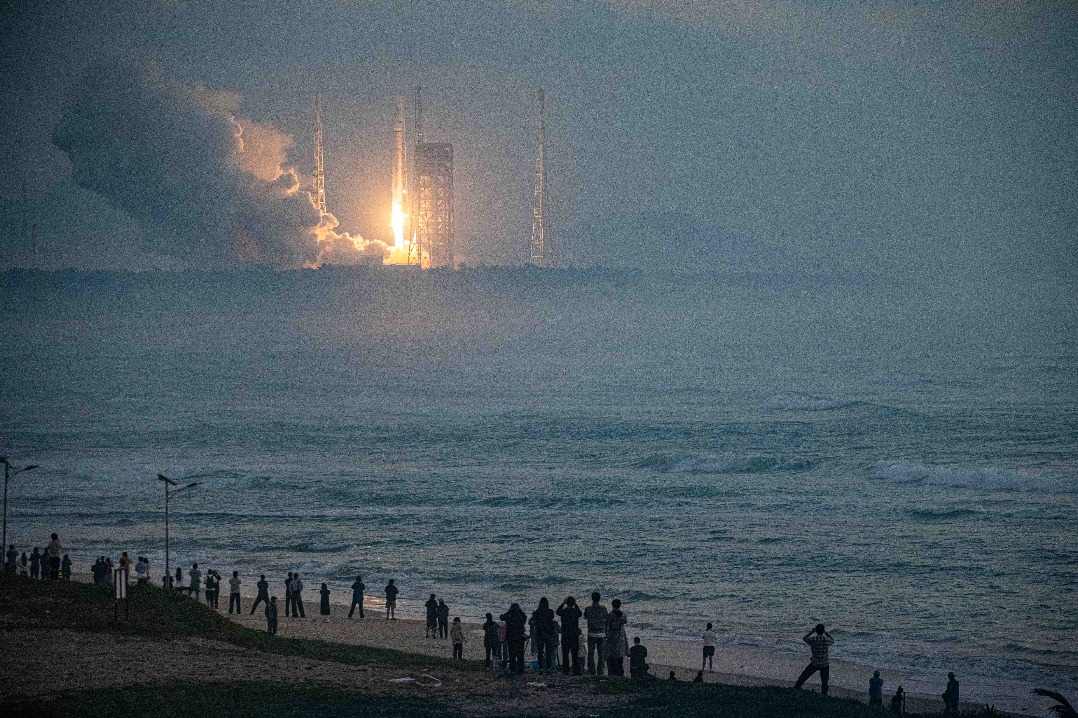
- China's Kuaizhou-11 Y8 rocket launches space experimental spacecraft into space
- Relic dates Jinan founding to around 4,200 years ago
- New rocket set to debut soon, launch six satellites
- Taiwan's character of the year a vote against confrontation